

Audemars Piguet Royal Oak Perpetual Calendar
The Audemars Piguet Royal Oak Perpetual Calendar brings together the unmistakable architecture of the Royal Oak with one of traditional watchmaking’s most sophisticated calendar complications. Designed for collectors who appreciate mechanical precision, distinctive case design and haute horlogerie craftsmanship, the Royal Oak Perpetual Calendar represents an important chapter in the history of Audemars Piguet.
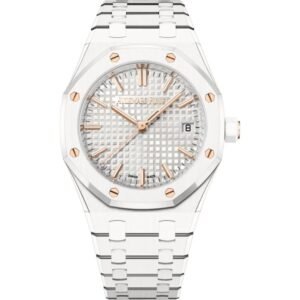
At LuxeChronos, this striking configuration is presented with a blue aventurine dial, creating a refined visual contrast that complements the technical character of the perpetual calendar. The deep blue appearance of aventurine gives the dial an expressive quality while the Royal Oak’s signature octagonal bezel and integrated bracelet maintain the recognizable identity of the collection.
The Audemars Piguet Royal Oak Perpetual Calendar is not simply a luxury sports watch with additional calendar displays. It represents the combination of an iconic Royal Oak design language and a high-level mechanical complication capable of tracking the calendar through changing month lengths and leap years.
Because Audemars Piguet has produced the Royal Oak Perpetual Calendar in numerous references, materials, dial configurations and generations, the exact reference and specifications should always be verified against the individual watch offered by LuxeChronos. Audemars Piguet’s own historical records document Royal Oak perpetual calendars dating back to the 1980s, as well as later 41 mm generations.
A Royal Oak With a Perpetual Calendar
The Royal Oak has been one of Audemars Piguet’s defining collections since its introduction in 1972. The design established an immediately recognizable combination of an octagonal bezel, exposed bezel screws, integrated bracelet architecture and contrasting polished and satin-brushed surfaces. Audemars Piguet’s historical archives describe the original Royal Oak as a significant turning point for the brand and Swiss watchmaking.
The Audemars Piguet Royal Oak Perpetual Calendar extends that design philosophy into the world of complicated watchmaking.
A perpetual calendar is designed to account for the different lengths of the months and the recurring leap-year cycle. Rather than simply displaying the date, a perpetual calendar mechanically tracks a much more complex calendar system.
This makes the complication particularly interesting to mechanical-watch collectors. The watch does not merely indicate the current time; its mechanism coordinates several calendar indications through a carefully engineered system of wheels, levers and cams.
The Royal Oak case provides a contemporary architectural frame for that traditional complication.
The Blue Aventurine Dial
One of the defining characteristics of this LuxeChronos configuration is its blue aventurine dial.
Aventurine is valued in watchmaking for its rich visual depth and distinctive surface appearance. Under changing light, a blue aventurine dial can reveal subtle variations in tone, producing a different visual effect depending on the angle of the watch.
This makes the dial particularly appropriate for a complicated Royal Oak. The intricate calendar displays create a strong mechanical identity, while the blue background provides visual depth.
Depending on the exact configuration, perpetual calendar displays can include the day, date, month, moon phase and leap-year indication. Audemars Piguet’s historical documentation confirms these functions across its Royal Oak perpetual calendar family.
For customers purchasing a specific example, the exact dial configuration should be checked against the product images and specifications supplied with that watch.
The Royal Oak’s Iconic Architecture
The Royal Oak’s design remains one of the most recognizable forms in modern luxury watchmaking.
Its octagonal bezel, exposed screws and integrated bracelet give it an appearance that is immediately distinguishable from conventional round luxury watches.
The architecture also creates a distinctive relationship between the case and bracelet. Rather than attaching a conventional strap or bracelet to separate lugs, the integrated design creates a continuous visual line from the case into the bracelet.
On a complicated model such as the Audemars Piguet Royal Oak Perpetual Calendar, that sporty architectural foundation is combined with an exceptionally traditional complication.
This contrast is part of the appeal of the Royal Oak Perpetual Calendar. It can look contemporary and architectural while housing a mechanism rooted in centuries of calendar-watch development.
The History of Audemars Piguet Perpetual Calendars
Audemars Piguet has a particularly important history with perpetual calendar wristwatches.
The company’s archives explain that the development of its ultra-thin self-winding perpetual calendar mechanism began during the quartz crisis. Calibre 2120/2800 was introduced in 1978 and measured just 3.95 mm thick. Audemars Piguet describes it as the world’s thinnest self-winding perpetual calendar movement at the time.
The Royal Oak adopted the perpetual calendar complication in the 1980s.
Audemars Piguet’s historical archive identifies the Royal Oak Perpetual Calendar model 25554 as appearing around 1984, with a 39 mm case and indications for the day, date, month and moon phases.
This historical connection helps explain why the Royal Oak Perpetual Calendar is more than another complicated sports watch. The model connects two important parts of Audemars Piguet’s history: the Royal Oak and the brand’s long development of ultra-thin perpetual-calendar movements.
The 41 mm Royal Oak Perpetual Calendar
A later generation expanded the Royal Oak Perpetual Calendar to a 41 mm case.
Audemars Piguet states that the Manufacture Calibre 5134 was introduced in 2015 and adapted the perpetual-calendar mechanism to a 41 mm case for model 26574. The movement maintained a thickness of 4.3 mm.
The 41 mm generation became an important modern interpretation of the Royal Oak Perpetual Calendar.
Audemars Piguet subsequently produced numerous versions using different materials and dial configurations. Official examples include an 18-carat white-gold Royal Oak Perpetual Calendar and an 18-carat pink-gold version.
This variety is important when researching the model online because the name Audemars Piguet Royal Oak Perpetual Calendar can describe multiple generations rather than one single specification.
Understanding the Perpetual Calendar Complication
A standard date watch generally requires manual adjustment at the end of months containing fewer than 31 days.
A perpetual calendar is designed to account for these differences mechanically.
The mechanism recognizes the different month lengths and incorporates the leap-year cycle. As a result, the calendar can continue displaying the correct date through months of different lengths when the mechanism is correctly maintained and operated.
This complexity is one reason perpetual calendars are considered significant complications within traditional mechanical watchmaking.
Audemars Piguet has been developing perpetual-calendar mechanisms for decades. Its historical archives document the evolution from the original Calibre 2120/2800 to later generations, including the Calibre 5134 and subsequent ultra-thin developments.
Calendar Indications
Depending on the exact Royal Oak Perpetual Calendar reference, the dial can display several calendar indications simultaneously.
These may include:
- Day of the week
- Date
- Month
- Moon phase
- Leap-year indication
The arrangement creates a dial that is considerably more information-rich than a conventional time-only Royal Oak.
Rather than treating the subdials as purely decorative, each indication is connected to the underlying calendar mechanism.
The exact placement and design of the indications can vary between generations and configurations, which is why collectors should verify the specific reference before purchasing.
Audemars Piguet Calibre 5134
The Calibre 5134 represents an important chapter in the development of the Audemars Piguet Royal Oak Perpetual Calendar.
Introduced in 2015, the self-winding Calibre 5134 adapted the perpetual-calendar mechanism for the larger 41 mm Royal Oak case while retaining a relatively thin profile. Audemars Piguet states that the movement measures 4.3 mm in thickness.
The movement’s history is particularly interesting because it was derived from Audemars Piguet’s long-running ultra-thin perpetual-calendar expertise.
The later Royal Oak 26574 generation helped bring renewed attention to the complication by combining the traditional calendar mechanism with the contemporary proportions and visual language of the 41 mm Royal Oak.
Collectors should note that not every Royal Oak Perpetual Calendar uses Calibre 5134. Later references use different movements, including the Calibre 5133 and other modern developments. Audemars Piguet’s archives document this progression.
A Complication With a Long History
The perpetual calendar has played an important role in Audemars Piguet’s history.
The brand’s archives explain that the original 1978 Calibre 2120/2800 was developed during the quartz crisis, when mechanical watchmaking faced enormous technological and commercial pressure from quartz watches.
Audemars Piguet continued developing complicated mechanical watches during this period, and the perpetual calendar became part of that broader commitment to traditional mechanical watchmaking.
For collectors, this historical context adds another dimension to the Audemars Piguet Royal Oak Perpetual Calendar.
The watch is simultaneously a modern Royal Oak, a complicated mechanical timepiece and an extension of a perpetual-calendar tradition that stretches back decades.
Case and Bracelet Design
The case and bracelet are central to the Royal Oak identity.
The integrated bracelet follows the geometry of the case and creates a continuous appearance around the wrist. Depending on the reference, the Royal Oak Perpetual Calendar may be produced in stainless steel, gold, ceramic or other advanced materials.
Audemars Piguet’s current and historical catalog includes examples in 18-carat white gold, pink gold and ceramic, demonstrating the breadth of the collection.
The exact material of the LuxeChronos example should be confirmed from the individual product listing.
For collectors, this is particularly important because case material can significantly alter the character of the watch.
White gold creates a discreet precious-metal appearance, pink gold introduces warmer tones, while ceramic can create a more contemporary and technical aesthetic.
Why Blue Works With the Royal Oak
Blue has become one of the most recognizable colors associated with modern luxury watches, and the Royal Oak’s geometry provides an especially effective background for a blue dial.
With an aventurine finish, the color can appear deep and dynamic rather than completely uniform.
The combination of a blue dial and the Royal Oak’s angular architecture creates a strong visual contrast between the dial and case.
On a complicated dial, this contrast also helps separate the calendar indications from the surrounding surface.
For the LuxeChronos product, the blue aventurine dial is therefore an important part of the watch’s visual identity rather than a minor detail.
Collecting an Audemars Piguet Royal Oak Perpetual Calendar
Collectors considering a Royal Oak Perpetual Calendar should look beyond the model name.
Because Audemars Piguet has produced the collection across multiple generations, it is important to identify the exact reference and configuration.
Before purchasing, consider:
- Reference number
- Case material
- Case diameter
- Dial configuration
- Movement
- Bracelet or strap
- Production year
- Condition
- Box and papers
- Service history
- Original accessories
- Any limited-edition status
These details can distinguish otherwise similar-looking watches.
If you are searching for a specific reference that is not currently listed, LuxeChronos provides a Request a Watch service where you can specify the model, reference, year, condition, configuration and budget.
Authenticity and Due Diligence
Authenticity is an important consideration when purchasing any high-value luxury watch.
This is particularly relevant for an Audemars Piguet Royal Oak Perpetual Calendar, because the model’s complexity means that proper identification requires more than simply examining the exterior.
Reference numbers, movement information, case construction, dial details, bracelet components and supporting documentation should all be considered.
LuxeChronos provides a dedicated Luxury Watch Authenticity resource for customers researching authentication and verification.
For a specific watch, buyers should also confirm that the reference and configuration correspond with the manufacturer’s documented specifications.
Audemars Piguet’s official website and AP Chronicles provide useful primary-source information about the Royal Oak Perpetual Calendar’s history and technical development.
Box and Papers
The availability of original accessories can differ between individual watches.
Depending on the specific example, accompanying materials may include:
- Original presentation box
- Warranty documentation
- User documentation
- Service records
- Additional bracelet links
- Other accessories
Customers should not assume that every Royal Oak Perpetual Calendar includes identical accessories.
The exact contents should be confirmed from the individual product listing before purchase.
If documentation or a particular configuration is important to you, contact LuxeChronos before completing an order.
New and Pre-Owned Royal Oak Watches
Luxury watches can be available in different conditions, including unworn, new and pre-owned examples.
Condition can influence the presentation and ownership experience of a complicated timepiece.
When evaluating a pre-owned Audemars Piguet Royal Oak Perpetual Calendar, buyers should consider the condition of the case, bezel, bracelet, crystal, dial and movement.
Previous polishing, bracelet condition, scratches, service history and replacement components may also be relevant.
A complicated mechanical watch can benefit from professional servicing over its lifetime, so available service documentation can provide useful information about the watch’s history.
For specific condition information, refer to the individual LuxeChronos listing or contact the team.
A Modern Expression of Haute Horlogerie
The Audemars Piguet Royal Oak Perpetual Calendar demonstrates how a highly complicated movement can be incorporated into a design that remains unmistakably contemporary.
The Royal Oak was originally notable for challenging traditional ideas about luxury watches by combining a sporty form with high-end finishing. Audemars Piguet’s archives describe the original 1972 Royal Oak as a major departure that brought together refinement, sport and design.
The perpetual calendar takes that concept further.
Instead of relying solely on precious materials or decorative finishing, the watch’s appeal also comes from the complexity of its mechanical function.
The result is a timepiece that can be appreciated from several perspectives: design, history, engineering and traditional Swiss watchmaking.
Explore Audemars Piguet at LuxeChronos
If the Audemars Piguet Royal Oak Perpetual Calendar is the model you are researching, you can explore the wider Audemars Piguet collection at LuxeChronos.
The collection includes Royal Oak, Royal Oak Offshore and other Audemars Piguet configurations.
Exploring multiple references can be particularly useful because case materials, dial designs, complications and bracelet configurations can vary significantly.
For collectors interested in other luxury brands, LuxeChronos also offers a selection of Rolex watches and other high-end timepieces.
Request a Specific Royal Oak
Not every Audemars Piguet reference is continuously available.
If you are searching for a particular Royal Oak Perpetual Calendar reference, dial, material or production year, you can use the LuxeChronos Request a Watch service.
Useful information to provide includes:
- Audemars Piguet
- Royal Oak Perpetual Calendar
- Reference number
- Preferred year
- Case material
- Dial color
- Bracelet or strap
- Condition
- Box and papers
- Budget
Providing the reference number is especially helpful when several versions of the same model exist.
Sell or Trade a Luxury Watch
Collectors sometimes want to change their collection rather than purchase an additional timepiece.
LuxeChronos also offers a Sell or Trade Your Watch service.
If you already own a Rolex, Audemars Piguet or another luxury watch, you can provide details about the model, reference, condition, accessories and other relevant information for consideration.
This can be useful for collectors looking to transition from one timepiece to another.
Frequently Asked Questions
What is the Audemars Piguet Royal Oak Perpetual Calendar?
The Audemars Piguet Royal Oak Perpetual Calendar is a Royal Oak model incorporating a perpetual calendar complication. Depending on the reference, it can display the day, date, month, moon phase and leap-year cycle.
What does a perpetual calendar do?
A perpetual calendar is a mechanical complication designed to account for the different lengths of the months and the leap-year cycle. It is significantly more complex than a standard date display.
When did Audemars Piguet introduce the Royal Oak Perpetual Calendar?
Audemars Piguet’s archives document the Royal Oak Perpetual Calendar appearing around 1984, following the development of the brand’s ultra-thin perpetual-calendar movement in 1978.
What is the 26574 Royal Oak Perpetual Calendar?
The 26574 is the model associated with the 41 mm generation of the Royal Oak Perpetual Calendar introduced in 2015 with the self-winding Calibre 5134.
Does every Royal Oak Perpetual Calendar use Calibre 5134?
No. Calibre 5134 was used for a particular generation beginning in 2015. Audemars Piguet subsequently developed other perpetual-calendar movements and references.
What does the Royal Oak Perpetual Calendar display?
Depending on the reference, the perpetual calendar can display the day, date, month, moon phase and leap-year indication. Historical Royal Oak examples documented by Audemars Piguet include these calendar functions.
Is the Royal Oak Perpetual Calendar available in different materials?
Yes. Audemars Piguet has produced Royal Oak Perpetual Calendar references in materials including stainless steel, 18-carat white gold, pink gold and ceramic. Exact availability depends on the reference.
What is an aventurine dial?
An aventurine dial is made using a glass-based material known for its deep appearance and sparkling visual effect. In a blue configuration, the surface can create a rich, star-like appearance that changes subtly under light.
How can I find a specific Royal Oak Perpetual Calendar reference?
You can submit the model and reference through the LuxeChronos Request a Watch page. You can provide the preferred year, condition, dial, case material, box and papers and budget.
Where can I verify Audemars Piguet specifications?
The official Audemars Piguet website and its AP Chronicles historical archive are useful primary sources for model history and specifications.
Final Thoughts
The Audemars Piguet Royal Oak Perpetual Calendar represents the meeting point between the unmistakable Royal Oak design and the demanding world of perpetual-calendar watchmaking.
Its story reaches back to Audemars Piguet’s development of ultra-thin self-winding perpetual-calendar mechanisms during the late 1970s. The Royal Oak subsequently adopted the complication in the 1980s, and later generations—including the 41 mm model 26574 introduced in 2015—continued to develop the concept for contemporary collectors.
The blue aventurine configuration offered by LuxeChronos adds another visual dimension to this complicated timepiece. Its deep blue dial creates a distinctive backdrop for the calendar indications while preserving the architectural character associated with the Royal Oak.
For anyone researching this model, the most important consideration is identifying the exact watch rather than relying only on the general model name. Reference, movement, case material, dial, condition, accessories and documentation should all be considered together.
Explore the Audemars Piguet collection at LuxeChronos, learn more about watch authenticity, or submit a Request a Watch inquiry for a specific Royal Oak Perpetual Calendar configuration.
Audemars Piguet Royal Oak Perpetual Calendar — an expression of Royal Oak design, mechanical complexity and traditional haute horlogerie.



Reviews
There are no reviews yet.