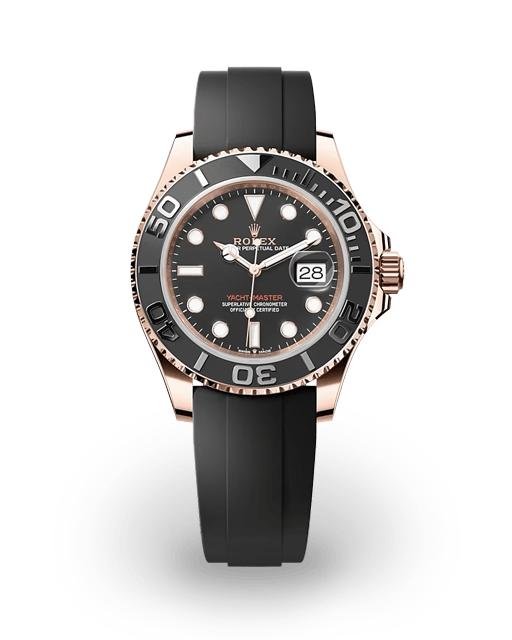
The Yacht Master Rolex is one of the most distinctive luxury sports watches in the Rolex collection. Designed around Rolex’s long-standing relationship with sailing, the Rolex Yacht-Master combines nautical styling, professional functionality, premium materials, and the mechanical engineering associated with one of the world’s most recognized watch brands.
Unlike the more tool-oriented Rolex Submariner, the Yacht-Master Rolex has a more luxurious and refined personality. It is designed to look equally at home on a yacht, at a marina, in a business environment, or at a formal event.
The current Rolex Yacht-Master collection includes 37 mm, 40 mm, and 42 mm models, with configurations using Oystersteel, platinum, gold alloys, Oystersteel and gold, and RLX titanium. Rolex also offers the watch with Oyster and Oysterflex bracelet options depending on the model.
For anyone researching the Yacht Master Rolex, this guide covers its history, design, sizes, materials, movement, features, pricing, and how it compares with other famous Rolex watches.
What Is the Yacht Master Rolex?
The Yacht Master Rolex is a luxury sports watch from Rolex that combines nautical functionality with a more sophisticated aesthetic.
Rolex launched the Yacht-Master in 1992, reinforcing the company’s relationship with the sailing world. Rolex describes the model as combining functionality and nautical style, making it suitable both on and off the water.
The watch is particularly recognizable for its:
Bidirectional rotating bezel
Raised 60-minute graduations
Premium materials
Oyster case
Mechanical automatic movement
Oyster or Oysterflex bracelet
Nautical-inspired design
Distinctive Rolex styling
The Rolex Yacht-Master is therefore more than simply a luxury watch with a nautical name. It is an important part of Rolex’s Professional category and reflects the company’s historic connection with yachting.
For shoppers exploring premium timepieces, you can also read our LuxeChronos guide to luxury mechanical watches to understand how Rolex’s mechanical movements work.
Rolex Yacht-Master History
The history of the Yacht Master Rolex is closely connected with Rolex’s relationship with sailing.
Rolex’s involvement with yachting stretches back decades. The company formed relationships with prestigious yacht clubs and sailing events before eventually introducing the Yacht-Master in 1992.
The Yacht-Master was designed specifically with sailors and navigators in mind, but Rolex also intended it to work as a luxurious everyday sports watch.
This dual-purpose identity helped distinguish the Yacht-Master from some of Rolex’s more specialized professional models.
The Yacht-Master could provide the functionality expected from a sports watch while offering a more luxurious appearance.
1992: The Yacht-Master Arrives
Rolex introduced the Yacht-Master in 1992.
According to Rolex’s official history, the model reinforced the brand’s ties with the sailing world and was designed specifically for sailors.
1999: Rolesium
In 1999, Rolex introduced Yacht-Master models using Rolesium, combining Oystersteel with platinum.
Rolex describes Rolesium as an Oystersteel case and bracelet paired with platinum elements.
This combination became one of the defining characteristics of several Rolex Yacht-Master models.
Modern Yacht-Master
The modern collection has expanded into multiple sizes and materials, including gold, Oystersteel and gold, platinum, and RLX titanium.
Rolex Yacht-Master Design
One of the main reasons the Yacht Master Rolex is so popular is its combination of sporty proportions and luxury finishing.
The watch has the familiar Rolex Oyster case architecture but adds design elements specifically associated with the Yacht-Master.
The Yacht-Master Bezel
The bezel is one of the most recognizable elements of the Rolex Yacht-Master.
It features a bidirectional rotating bezel with raised 60-minute graduations.
This allows the wearer to measure elapsed time, including timing intervals relevant to sailing. Rolex describes the bezel as an important functional and visual element of the Yacht-Master.
Depending on the reference, the bezel can use precious metal or a Cerachrom ceramic insert.
The combination of polished raised numerals and a contrasting background creates the distinctive Yacht-Master appearance.
Rolex Yacht-Master Sizes
One of the advantages of the current Yacht Master Rolex collection is the availability of multiple case sizes.
Rolex currently lists the Yacht-Master in:
37 mm
40 mm
42 mm
This makes the collection suitable for different wrist sizes and style preferences.
Rolex Yacht-Master 37
The Rolex Yacht-Master 37 is the smallest current Yacht-Master size.
At 37 mm, it provides a more compact appearance while retaining the essential Yacht-Master design.
Current configurations include Oystersteel and Everose gold, Oystersteel and platinum, and Everose gold, depending on the reference.
The Yacht-Master 37 is an excellent option for people who prefer a smaller luxury sports watch.
Rolex Yacht-Master 40
The Rolex Yacht-Master 40 is arguably one of the most versatile sizes in the collection.
At 40 mm, the watch has a balanced wrist presence without being excessively large.
Rolex currently offers Yacht-Master 40 configurations including Oystersteel and platinum, Oystersteel and Everose gold, and Everose gold.
The Yacht-Master 40 can work particularly well as an everyday luxury watch.
It is large enough to have a strong wrist presence while remaining relatively versatile.
For many buyers searching for a Rolex Yacht-Master for men, the 40 mm size is an especially appealing option.
Rolex Yacht-Master 42
The Rolex Yacht-Master 42 offers a larger modern interpretation of the collection.
Current configurations include yellow gold, white gold, and RLX titanium.
The RLX titanium version is particularly interesting because titanium provides a combination of strength and lightness.
Rolex describes RLX titanium as a specially selected Grade 5 titanium alloy chosen for its strength and low weight.
For men who prefer larger watches, the Yacht-Master 42 offers substantial wrist presence without abandoning the Yacht-Master’s refined design.
Rolex Yacht-Master Materials
The materials used in a Yacht Master Rolex can dramatically change the appearance and price of the watch.
Current Yacht-Master models include combinations of:
Oystersteel
Platinum
Everose gold
Yellow gold
White gold
Oystersteel and gold
RLX titanium
Rolesium
Rolesium is one of the most recognizable Yacht-Master material combinations.
Rolex introduced Rolesium on the Yacht-Master in 1999.
It combines Oystersteel with platinum elements, creating a contrast between the practical properties of Oystersteel and the luxury appearance of platinum.
For many collectors, a Rolesium Rolex Yacht-Master represents one of the most distinctive versions of the watch.
Rolex Yacht-Master Oysterflex Bracelet
Another important feature of modern Rolex Yacht-Master models is the Oysterflex bracelet.
Rolex introduced the Oysterflex bracelet on the Yacht-Master 37 in 2015.
The bracelet uses metal blades covered with a high-performance elastomer.
This creates a combination of structural strength and flexible comfort.
The Oysterflex bracelet also gives the Yacht-Master a sportier appearance compared with a traditional Oyster bracelet.
For buyers who want a modern luxury sports watch, the Oysterflex configuration can be particularly attractive.
Rolex Yacht-Master Movement
The Yacht Master Rolex is powered by Rolex mechanical movements.
For example, the current Yacht-Master 40 reference 126621 uses Rolex Calibre 3235.
Rolex lists the movement as:
Perpetual mechanical
Self-winding
Approximately 70-hour power reserve
-2/+2 seconds per day precision after casing
Parachrom hairspring
Paraflex shock absorbers
Superlative Chronometer certification
This demonstrates that the Yacht-Master is not simply about appearance.
Its mechanical movement is engineered to provide precision, reliability, and long-term performance.
Rolex Yacht-Master 40 Calibre 3235
The Calibre 3235 is an important part of the current Yacht-Master 40 configuration.
The movement uses a bidirectional self-winding system powered by Rolex’s Perpetual rotor.
Rolex lists approximately 70 hours of power reserve for the Yacht-Master 40 reference 126621.
For someone who rotates several watches during the week, a substantial power reserve can be especially useful.
The movement also includes a date function and stop-seconds mechanism for precise time setting.
Rolex Yacht-Master Water Resistance
The Oyster architecture is an important part of Rolex’s sports-watch identity.
Rolex developed the original Oyster case as a waterproof and dustproof wristwatch architecture, using a screw-down bezel, case back, and winding crown.
The Yacht-Master continues the Oyster-case philosophy.
However, buyers should always check the specific reference’s official specifications and follow Rolex’s recommendations for water exposure.
The Yacht-Master is associated with sailing and marine environments, but that does not mean every Yacht-Master configuration should be treated as a professional dive watch.
If diving capability is your priority, the Rolex Submariner is designed specifically around diving.
Rolex Yacht-Master vs Submariner
One of the most common comparisons is Rolex Yacht-Master vs Submariner.
Although both are luxury sports watches, they serve different purposes.
| Feature | Yacht-Master | Submariner |
|---|---|---|
| Primary identity | Nautical luxury sports watch | Professional dive watch |
| Bezel | Bidirectional | Unidirectional |
| Design | More luxurious/refined | More tool-oriented |
| Materials | Broad luxury-material selection | Strong emphasis on robust sport configurations |
| Sizes | 37, 40, 42 mm | Primarily 41 mm in current collection |
| Sailing heritage | Strong | Strong marine heritage but focused on diving |
| Best for | Luxury sports style | Diving and tool-watch enthusiasts |
The Yacht Master Rolex generally has a more luxurious and dress-friendly personality.
The Submariner is more strongly associated with diving and professional underwater use.
If you want a watch that transitions between casual, nautical, business, and formal environments, the Yacht-Master can be especially attractive.
Rolex Yacht-Master vs Yacht-Master II
It is important not to confuse the Rolex Yacht-Master with the Yacht-Master II.
They are substantially different watches.
The standard Yacht-Master focuses on nautical styling, elapsed-time functionality, luxury materials, and everyday versatility.
The Yacht-Master II was developed around the specialized requirements of yacht racing and includes a programmable countdown with mechanical memory.
Rolex’s official collection lists the Yacht-Master and Yacht-Master II as separate models.
For most buyers looking for a luxury nautical Rolex, the standard Yacht-Master is likely the more versatile option.
Rolex Yacht-Master Price
The price of a Yacht Master Rolex varies considerably depending on the size, material, reference, bracelet, dial, and market.
Rolex’s current official US listings show examples ranging from the lower five figures for certain steel/platinum configurations to substantially higher prices for precious-metal models.
For example, Rolex’s current listings include:
Yacht-Master 40 in Oystersteel and platinum
Yacht-Master 37 in Oystersteel and platinum
Yacht-Master 40 in Oystersteel and Everose gold
Yacht-Master 37 in Everose gold
Yacht-Master 42 in yellow gold
Yacht-Master 42 in white gold
Yacht-Master 42 in RLX titanium
Because Rolex pricing and availability can change, buyers should check the official Rolex website for current pricing rather than relying on outdated articles.
See the current Rolex Yacht-Master collection.
Is the Rolex Yacht-Master a Good Investment?
The Rolex Yacht-Master can be desirable among collectors, but buyers should distinguish between purchasing a watch they love and treating a watch as a guaranteed investment.
Luxury-watch prices can change based on:
Market demand
Condition
Reference
Materials
Rarity
Production
Originality
Box and papers
Market conditions
Dealer availability
There is no guarantee that a particular Yacht-Master will appreciate.
The strongest reason to buy a Yacht Master Rolex should be that you genuinely like the watch and understand its ownership costs.
For broader Rolex buying advice, see our LuxeChronos guides on the best Rolex watches to buy and where is the best place to buy a Rolex watch.
Is the Rolex Yacht-Master Good for Everyday Wear?
Yes.
One of the strengths of the Rolex Yacht-Master is its versatility.
The watch combines sports-watch functionality with a more luxurious appearance.
Depending on the configuration, it can work with:
Casual clothing
Business clothing
Smart-casual outfits
Evening wear
Nautical clothing
Formal occasions
The 40 mm version can be particularly versatile for everyday wear.
The 37 mm model provides a smaller wrist presence, while the 42 mm version is more substantial.
Who Should Buy a Rolex Yacht-Master?
The Yacht Master Rolex is particularly suitable for someone who wants:
A luxury sports watch
Nautical styling
Rolex craftsmanship
Premium materials
Automatic mechanical movement
A distinctive bezel
Everyday versatility
A watch suitable for casual and formal environments
It may be less suitable for someone who specifically needs a professional dive watch.
In that case, the Submariner or Sea-Dweller may be more appropriate.
Best Rolex Yacht-Master for Men
For men researching the best Rolex Yacht-Master, the ideal size depends largely on wrist size and personal preference.
Yacht-Master 40
The 40 mm Yacht-Master is a strong all-around choice.
It offers a balanced combination of presence, comfort, and versatility.
Yacht-Master 42
The 42 mm Yacht-Master is better suited to men who prefer larger watches.
The RLX titanium version is particularly interesting for buyers who want a large watch without excessive weight.
Yacht-Master 37
Although smaller, the 37 mm Yacht-Master can work exceptionally well for men with smaller wrists or anyone who prefers contemporary smaller-case proportions.
How to Tell if a Rolex Yacht-Master Is Real
Because the Yacht-Master is a valuable luxury watch, authenticity should always be taken seriously.
When purchasing a pre-owned Rolex Yacht-Master, pay attention to:
Reference number
Serial information
Movement
Dial printing
Bezel
Case finishing
Bracelet
Clasp
Crown
Documentation
Seller reputation
Service history
However, visual inspection alone is not always enough to establish authenticity.
For expensive purchases, professional authentication is strongly recommended.
Our LuxeChronos guide on how to tell if a Rolex is real provides additional information about Rolex authentication.
Rolex itself states that official Rolex jewelers are authorized to sell and maintain Rolex watches and have the necessary skills, technical knowledge, and equipment to guarantee the authenticity of Rolex components.
How to Maintain a Rolex Yacht-Master
Proper maintenance can help keep your Yacht-Master functioning correctly for many years.
Basic care includes:
Keep the Crown Properly Secured
Make sure the crown is properly screwed down according to Rolex’s instructions before exposing the watch to water.
Rinse After Saltwater Exposure
If your watch has been exposed to seawater, appropriate rinsing and care can help remove salt and residue.
Avoid Unnecessary Impacts
Although Rolex sports watches are designed for durability, unnecessary shocks should still be avoided.
Service the Watch Professionally
Mechanical watches require professional maintenance.
Use an authorized Rolex service provider or qualified professional according to the manufacturer’s recommendations.
Keep Documentation
If you own a collectible or valuable Yacht-Master, maintaining the original documentation and service records can be useful.
Rolex Yacht-Master Buying Guide
Before buying a Yacht Master Rolex, consider these factors.
1. Choose Your Size
Decide between 37 mm, 40 mm, and 42 mm.
2. Choose Your Material
Consider whether you prefer:
Oystersteel and platinum
Oystersteel and Everose gold
Everose gold
Yellow gold
White gold
RLX titanium
3. Choose Your Bracelet
Depending on the reference, you may be choosing between an Oyster bracelet and Oysterflex.
4. Choose Your Dial
The dial can significantly influence the personality of the watch.
5. Consider Your Lifestyle
If you want an everyday luxury watch, prioritize comfort and versatility.
If the watch will primarily be worn at formal events, precious-metal configurations may be more attractive.
6. Buy From a Reputable Source
Check the seller’s reputation, authenticity guarantees, warranty, return policy, and documentation.
Rolex Yacht-Master for Collectors
Collectors are often attracted to the Yacht-Master because of its combination of Rolex heritage and distinctive nautical identity.
Important factors for collectors include:
Reference
Production period
Material
Dial configuration
Bezel
Bracelet
Condition
Originality
Documentation
Service history
Rare configurations can be particularly interesting, but collectors should conduct thorough research before paying a premium.
Why the Yacht Master Rolex Remains Popular
The continued appeal of the Yacht Master Rolex comes from its ability to combine several characteristics that do not always appear together.
It is:
Sporty.
Luxurious.
Nautical.
Mechanical.
Versatile.
Recognizable.
Collectible.
The Yacht-Master does not attempt to be a pure dive instrument like the Submariner.
Instead, it occupies a more luxurious space between a professional sports watch and a sophisticated everyday Rolex.
That unique positioning is one of its greatest strengths.
Final Verdict: Is the Rolex Yacht-Master Worth It?
The Rolex Yacht-Master is one of the most distinctive watches in the Rolex collection.
Its history is connected to sailing, while its modern designs combine Rolex’s mechanical watchmaking with premium materials, sophisticated finishing, and versatile styling.
The current collection offers 37 mm, 40 mm, and 42 mm sizes, giving buyers several options depending on wrist size and personal preference.
The Yacht-Master 40 is an excellent all-around choice for buyers who want versatility.
The Yacht-Master 42 provides a larger presence and includes particularly interesting configurations such as RLX titanium.
The Yacht-Master 37 offers a more compact alternative.
Ultimately, the best Yacht Master Rolex is the one that matches your wrist, lifestyle, budget, and personal taste.
For anyone looking for a luxury sports watch with strong Rolex heritage but a more refined nautical character than the Submariner, the Yacht-Master deserves serious consideration.
Explore the LuxeChronos luxury watch collection for more luxury-watch guides and discover our other resources on Rolex, Patek Philippe, Audemars Piguet, Hublot, and other prestigious watch brands.
Frequently Asked Questions About the Yacht Master Rolex
What is the Yacht Master Rolex?
The Yacht Master Rolex, officially called the Rolex Yacht-Master, is a luxury sports watch introduced in 1992 and associated with Rolex’s long-standing relationship with sailing.
When was the Rolex Yacht-Master introduced?
Rolex introduced the Yacht-Master in 1992. The model reinforced the brand’s connection with the sailing world.
What sizes does the Rolex Yacht-Master come in?
The current Rolex Yacht-Master collection includes 37 mm, 40 mm, and 42 mm models.
Is the Rolex Yacht-Master automatic?
Yes. Current Yacht-Master models use self-winding mechanical movements. For example, the Yacht-Master 40 reference 126621 uses Rolex Calibre 3235 with bidirectional self-winding.
How much is a Rolex Yacht-Master?
The price depends on the model, size, material, and configuration. Current official Rolex prices vary considerably between Oystersteel and platinum, two-tone, precious-metal, and RLX titanium models.
Is the Yacht-Master better than the Submariner?
Neither is universally better. The Yacht-Master emphasizes luxury and nautical styling, while the Submariner is specifically associated with professional diving.
Is the Rolex Yacht-Master a dive watch?
The Yacht-Master is a nautical sports watch, but it should not be confused with Rolex’s dedicated professional dive watches such as the Submariner and Sea-Dweller.
Is the Yacht-Master good for everyday wear?
Yes. Its combination of sports-watch functionality and luxury styling makes it suitable for everyday wear, depending on the configuration.
Is the Rolex Yacht-Master a good investment?
It can be collectible and desirable, but there is no guaranteed investment return. Buyers should purchase primarily because they appreciate the watch rather than assuming future price appreciation.